The Rice Family And Their Legacy
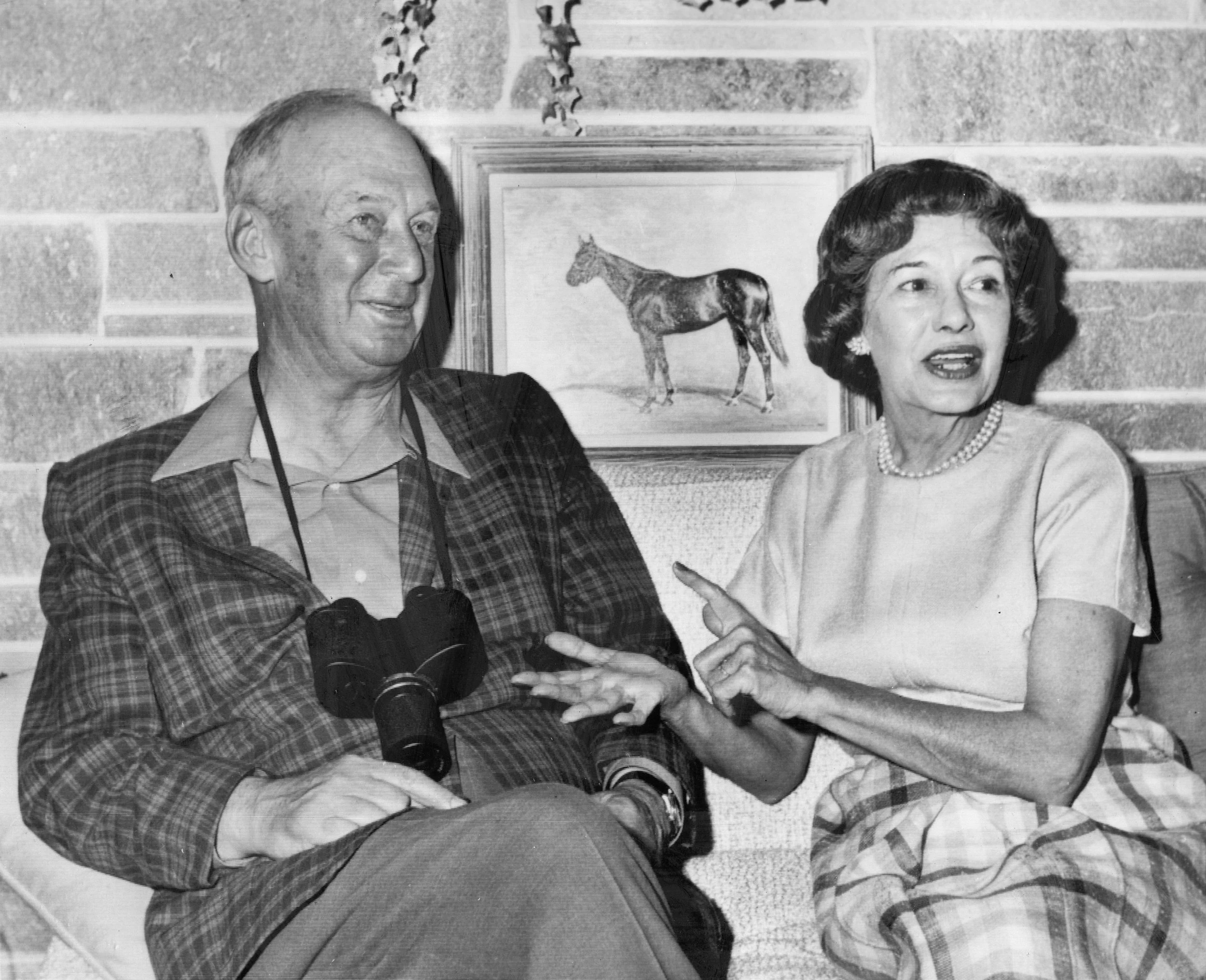
Danada is a property rich in the story of one self-made man’s American dream. Daniel F. Rice was born on March 3, 1896, in Chicago and rose from humble origins to become a prominent commodities trader. After a brief stint in Army officer training during World War I, Dan returned to Chicago and joined the Board of Trade, where he gained renown as one of the most daring grain speculators in the pits.
By 1919 he had founded his own brokerage, Daniel F. Rice & Company, which grew to 200 employees with offices nationwide. In 1930 his firm moved into the Board of Trade Building, and in 1960 he merged it with Hayden, Stone & Co. Dan’s business success allowed him to branch into related ventures. He co-owned grain elevators, served as president of Rice Grain Corporation in Chicago, and invested in professional sports, including part ownership of the Los Angeles Dons football franchise in the 1940s. He loved golf, fishing, hunting, and especially horses.
Around 1917, Dan met Ada Lucille Bousman (née Perrigo), a petite brown-eyed young woman from Danville, Illinois, who had moved to Chicago to work as a telephone clerk. Ada was born June 13, 1898. Her early life held challenges, since her father’s identity is unknown and she was raised by her mother and stepfather, but she had a lively spirit and many talents.
Dan and Ada fell in love and married on April 22, 1920, at St. Sebastian’s Church in Chicago. In 1928 they adopted a five-month-old baby boy and named him Daniel F. Rice Jr. Their son completed the family that would eventually create Danada.
Building “Danada”
Fueled by his Board of Trade success, Dan developed a strong interest in agriculture and open land. In 1929, the Rices purchased 152 acres of farmland between Wheaton and Naperville, Illinois. They coined the name “Danada,” blending Dan and Ada, for their new estate. Over the following years, Dan steadily acquired adjoining parcels, expanding Danada to roughly 1,350 acres of Illinois countryside.
The farm became a diversified operation in the 1930s and 1940s. It produced corn, soybeans, wheat, and other crops, raised sheep, hogs, cattle, chickens, and turkeys, and included an apple orchard. Danada was both a working farm and a country retreat for the Rice family.
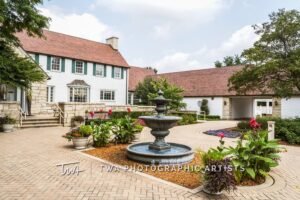
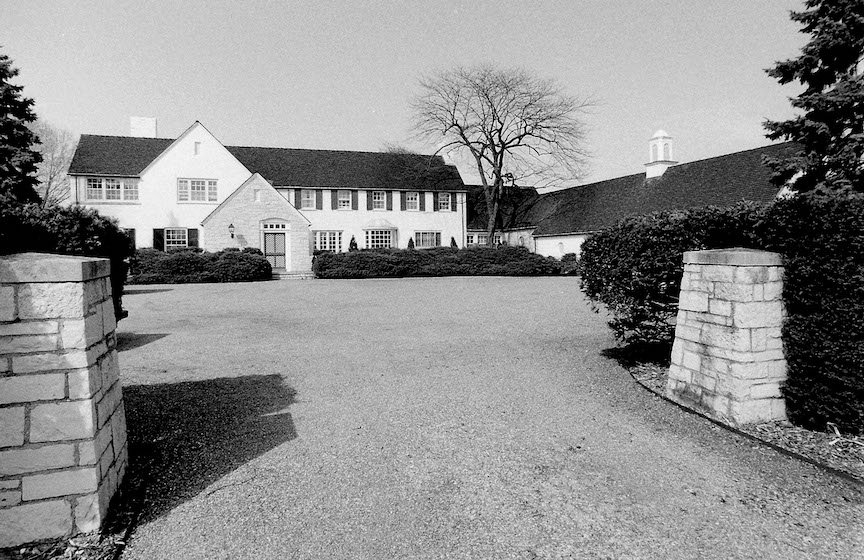
In 1939, Dan and Ada built a grand 19-room mansion on the property that would later be known as
Danada House. The two-story brick home featured elegant living and dining rooms, a library, an office, a large kitchen and breakfast room, plus pantries and utility rooms on the main floor. Upstairs were four spacious bedrooms, a nanny’s room, and four bathrooms.
The basement level was designed for entertaining, with a bar, billiards room, dance floor, wine cellar, and changing rooms for the outdoor swimming pool. Outside, the estate included formal gardens, a reflective pool, a skeet shooting and trap area where Ada, an expert markswoman, practiced, and broad lawns for gatherings and events. The Rices became known for their generous hospitality. Guests at Danada included Hollywood actor Don Ameche, comedian Jimmy Durante, pianist Liberace, and famed jockey Bill Shoemaker, who visited frequently on golfing weekends.
Ada’s Racing Stable
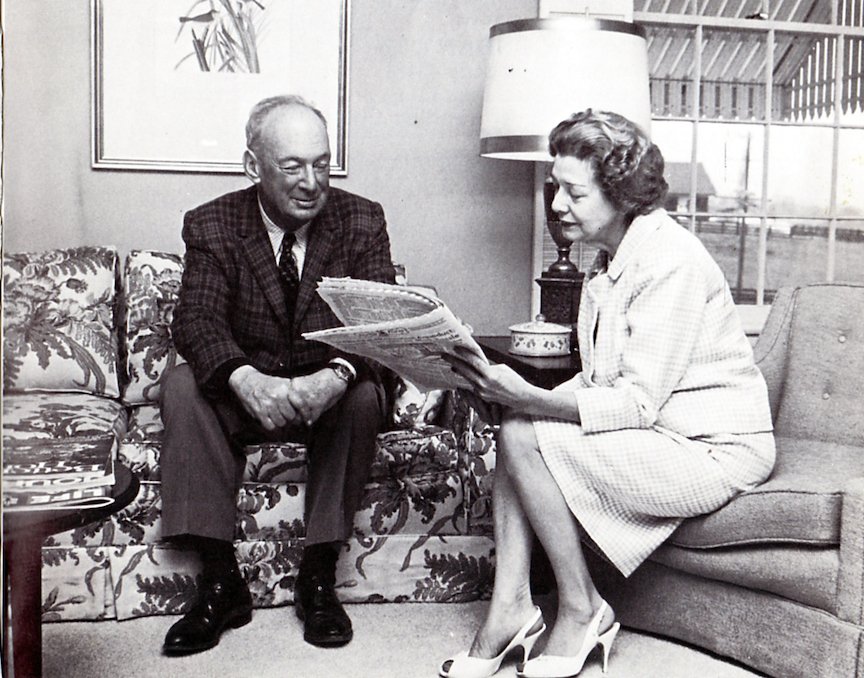
In 1943, Ada mentioned to Dan that it “would be fun to own some racehorses.” Dan took her wish seriously. At a Fasig-Tipton auction in Lexington, Kentucky, he purchased eight Thoroughbred yearlings for her, and seven of the eight won races in their first year. Ada was immediately captivated by the sport.
She established the Ada L. Rice Racing Stables and selected racing colors of cerise (bright pink) and white. Her jockey silks had a distinctive pink shimmer with the initials “ALR” emblazoned on a white diamond. To support the stable, the Rices built a state-of-the-art equestrian facility on the Wheaton farm that would later connect to today’s Danada Equestrian Center.
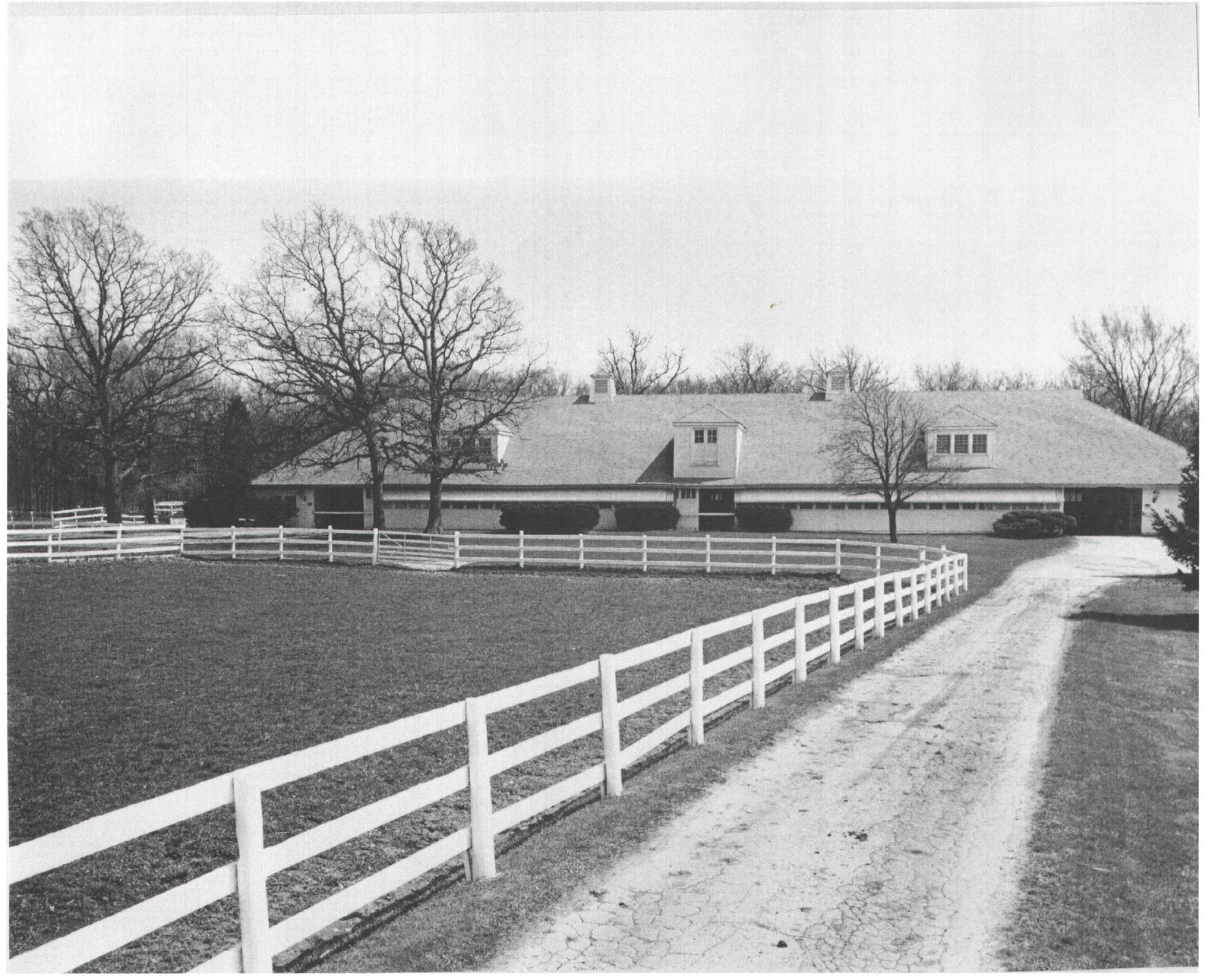
By the mid-1940s, the farm included a 26-stall Kentucky-style barn with a full-time veterinarian and an X-ray machine for the horses. A half-mile training track with an electronic starting gate and a buzzer and bell system helped young horses become accustomed to race conditions. Danada’s racing operation expanded further in 1947 when Dan and Ada acquired a second farm near Lexington, Kentucky, part of Colonel E. R. Bradley’s famous Idle Hour Farm, which they also called Danada. Breeding stock was kept in Kentucky, while the primary training stable remained in Illinois, and horses were shuttled between the two locations.
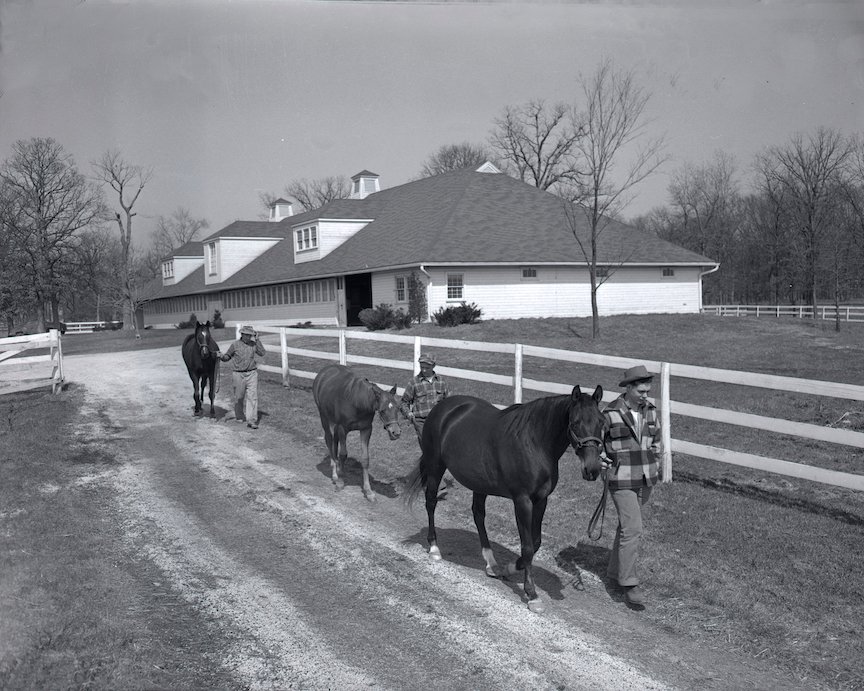
At their peak, the two Danada farms housed as many as 130 horses, with roughly 65 in training and another 65 broodmares, foals, and stallions. Over the decades, Ada L. Rice Stables became one of the leading Thoroughbred operations in the United States. Horses raced by Mrs. Rice won 883 races and earned more than $8.7 million through 1974. Horses bred by the Rices won 2,310 races and earned approximately $13.15 million.
The pinnacle of the racing operation came in 1965 when Danada’s homebred Lucky Debonair won the Kentucky Derby with Bill Shoemaker in the saddle. That year was especially notable. Lucky Debonair’s Derby victory in 2:01.2 was the third-fastest time on record at that time, and the stable’s star Pia Star equaled a world record and defeated legendary horses like Kelso in major stakes races.
Dan’s role went beyond ownership. He became deeply involved in the business side of racing, serving on the board of Arlington Park, holding major shares in Washington Park and Hialeah race tracks, and helping to found the Thoroughbred Owners and Breeders Association (TOBA). In 1957, the Jockeys’ Guild named him Man of the Year, and in 1964 DePaul University awarded him an honorary doctorate for his civic contributions.
Philanthropy And The Rice Foundation
Even as they bred champions on the track, Dan and Ada were generous civic leaders off the track. In 1947, they established the Daniel F. and Ada L. Rice Foundation, using their fortune to support causes they believed in. Over the next 40 years, the foundation awarded about 1,257 grants totaling $12.4 million. By 1988, it held assets of more than $60 million to continue charitable giving. Additional information about specific grants can be found in the
Rice Donations and Grants section.
The Rices focused their philanthropy on preventing child abuse, advancing medical research, supporting education, and conserving wildlife and plants. They made significant personal gifts during their lifetimes, including $10 million to the Art Institute of Chicago, $3 million to the Shedd Aquarium, and $2 million to the Chicago History Museum. They also donated land, giving approximately 19 acres to support an Illinois Institute of Technology campus in Wheaton and 13 acres to the Wheaton Park District, where the Rice Pool & Water Park and a community center were built.
Across the Chicago region, many institutions today bear the Rice name, from conservation facilities to science centers. Their philanthropy extended the Danada story far beyond the borders of the farm itself.
From Private Estate To Public Preserve
Dan Rice died in February 1975 at age 78 while wintering at his home on Indian Creek Island in Florida. Ada Rice died two years later, in April 1977, also at age 78. Neither left a will that clearly directed the future of Danada, and for a time it appeared that the land might be sold for subdivision or commercial development.
Local residents, preservation groups, and civic leaders rallied to protect the property through the “Save the Rice Farm” effort. Their work, combined with the leadership of the Forest Preserve District of DuPage County, ultimately ensured that much of the estate would be preserved. In 1980, the Forest Preserve District acquired approximately 780 acres of the original Danada property. The land became part of what is now the
Danada Forest Preserve.
By 1983, the grounds opened to the public. The original mansion was restored and converted into Danada House, a rental facility and historic site. The equestrian facilities evolved into today’s Danada Equestrian Center, which offers riding lessons and public programs. Volunteers with Friends of Danada began maintaining the Danada Model Farm to interpret 1950s–1960s farming methods.
Today, visitors can walk or ride through Danada’s prairies and woodlands, attend events like the annual Danada Fall Festival, and see memorials to Lucky Debonair near the old training track. The transformation from private estate to public preserve ensures that the story of the Rice family and Danada continues to be shared with future generations.